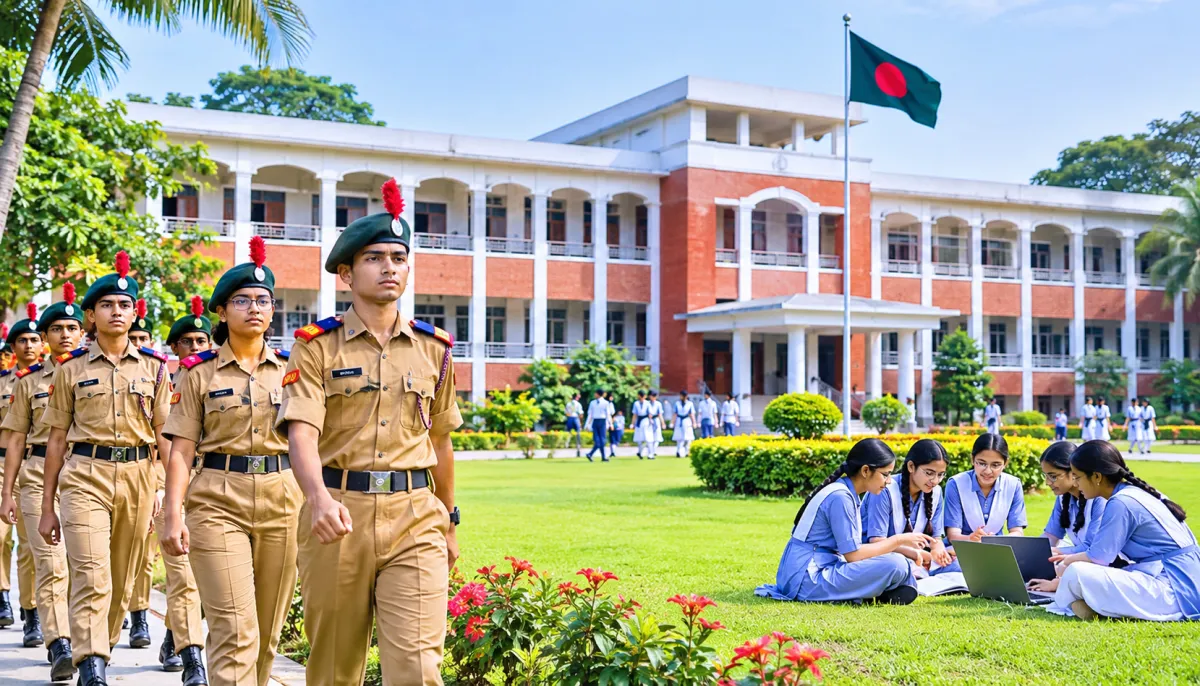
The proposed Tk 68,400 crore project would establish separate residential schools for boys and girls in all 300 parliamentary constituencies.
The government plans to build 600 residential model schools and colleges across Bangladesh, following the cadet college model. The proposed institutions would include one school for boys and another for girls in each of the country’s 300 parliamentary constituencies.
The institutions would provide education from Class Six to Class Twelve. They would also offer residential facilities, sports, swimming, cultural activities and training in modern technology. However, the project has not yet received final approval.
The Secondary and Higher Education Division of the Ministry of Education has sent a Preliminary Development Project Proposal (PDPP) to the Planning Commission. The proposed project, titled Construction of 600 Model Schools and Colleges in Selected Areas of Bangladesh, would be implemented by the Directorate of Secondary and Higher Education (DSHE).
According to the proposal, the project would cost Tk 68,400 crore. The government plans to finance 30 percent, or Tk 20,520 crore, from its own funds. The remaining 70 percent, worth Tk 47,880 crore, is expected to come from foreign assistance.
Several development partners have been mentioned as potential sources of funding. These include the World Bank, Asian Development Bank (ADB), Asian Infrastructure Investment Bank (AIIB), Japan International Cooperation Agency (JICA), Korea’s EDCF and the Islamic Development Bank. However, none of these organisations has confirmed any financial commitment.
600 institutions planned across 300 constituencies
Under the proposal, each parliamentary constituency would receive two separate institutions. One would serve boys, while the other would serve girls.
Each institution would require approximately three acres of land. As a result, the project would need around 1,800 acres for all 600 schools and colleges.
The proposed institutions would accommodate between 1,000 and 1,100 students each. They would offer classes from Six to Twelve, with three to four sections in each class. Each section would have around 38 to 40 students.
Together, the 600 institutions would have the capacity to accommodate approximately 600,000 students.
However, the proposal does not explain in detail how authorities would select locations. Factors such as local student numbers, population, existing educational facilities and demand would need further assessment.
A feasibility study is expected to examine land availability, site selection and other related matters.
Modern classrooms and technology facilities
The proposed schools would have modern multi-storey academic buildings, general classrooms and multimedia classrooms. They would also include laboratories for physics, chemistry and biology.
Specialised facilities would support the study of science, technology, artificial intelligence (AI) and robotics. Digital learning centres, e-libraries and internet connections across the campuses are also planned.
Students would have access to language laboratories to learn Japanese, Korean, Arabic and Mandarin, alongside Bangla and English.
The proposal also includes libraries, auditoriums and cultural centres. Students would be able to take part in music, dance, drama and fine arts activities.
Science clubs, debate competitions, sports and other extracurricular activities would also form part of the programme. These activities are intended to develop students’ creativity and leadership skills.
Hostels, swimming pools and meal facilities
Each institution would have a residential hostel with 100 beds. The campuses would also include playgrounds, football and cricket grounds, indoor sports facilities and swimming pools.
The swimming facilities would help students learn how to swim and develop basic life-saving skills.
The proposal also includes central kitchens and dining halls. These facilities would provide students with hygienic meals and support proper nutrition.
For this purpose, the project proposes an operational approach based on Japan’s school meal and nutrition education system.
Each institution would also have medical and first-aid rooms, school nurses and mental health support services. Counselling facilities would be available to help students with their personal and educational needs.
Separate common rooms for girls, hygienic toilets and menstrual health facilities are also planned. Ramps, lifts and barrier-free access would support students with disabilities.
The proposed security arrangements include boundary walls, controlled entry points, CCTV cameras and fire safety systems.
Green campuses and environmental facilities
The project also aims to develop environmentally friendly campuses. Proposed facilities include rooftop solar power systems, rainwater harvesting and water recycling.
Waste management, tree plantation and gardening activities would also be included. Students would have opportunities to take part in campus gardening and other environmental activities.
Around 27,000 teachers needed
Each institution would require approximately 45 teachers. Therefore, the 600 schools and colleges would need around 27,000 teachers.
The proposed student-teacher ratio would be approximately 22:1. This means there would be around 22 students for every teacher.
Besides teachers, the institutions would need administrative officers and other staff. Laboratory technicians, IT personnel, librarians, nurses and food management workers would also be required.
Hostel supervisors and security personnel would be needed to manage the residential facilities and ensure student safety.
Funding and land acquisition pose major challenges
Securing the required funding is one of the biggest challenges facing the project. Around Tk 47,880 crore would need to come from foreign assistance.
The proposal does not yet confirm whether the potential development partners will provide this amount. Without secured funding, the project cannot move towards full implementation.
Land acquisition for 600 institutions would also require significant planning. Completing construction within five years and recruiting around 27,000 teachers would present further challenges.
The long-term operating costs are another major concern. Residential facilities, swimming pools, laboratories, medical services and other facilities would require regular funding.
However, the proposal does not provide a final framework explaining how these expenses would be managed or which budgetary sources would cover them.
Feasibility study proposed at Tk 4.50 crore
According to documents from the Planning Commission, Tk 4.50 crore has been proposed for the project’s feasibility study.
The study would assess the need for the institutions, suitable locations, land availability, estimated costs and possible sources of financing. It would also examine whether the project could be implemented as planned.
After the study, authorities would need to prepare a Detailed Development Project Proposal (DPP). This would provide a more detailed framework for the project’s implementation.
Planning Commission officials said the project is not included in the list of approved new projects for the 2026–27 fiscal year.
They indicated that further steps would depend on the interest of development partners and the availability of financing. The feasibility study, DPP preparation and other procedures would then have to follow the relevant rules.
The proposed project is planned for five years, from September 1, 2026, to August 30, 2031. However, construction cannot begin under the current proposal until the government grants final approval and the necessary funding is secured.